Cirugía de la Mirada®
Cirugía de la Mirada® is a concept for periorbital rejuvenation that I developed and registered. It is based on a simple idea: the eye area should be treated as a single unit, not as a collection of separate structures.
Rejuvenation of the upper third of the face is often planned around one specific area (usually the eyelid). However, eyes that look tired, older or sad rarely depend on a single structure.
The position of the forehead and brows, excess or deficient volume in the eyelids, eye bags, tear troughs, the canthus and the temporal region all contribute together to the expression of the eyes.
That is why Cirugía de la Mirada® is not a specific technique, but a way of reaching a diagnosis before deciding which technique to use.
In some patients, treating the eyelids will be enough. In others, it will also be necessary to address brow position, restore volume, soften certain transitions or combine several procedures.
The goal is not simply to rejuvenate the eyelid, but to make the whole eye area look more open, rested and harmonious, preserving the patient's expression and avoiding a fragmented or artificial result.
What the eye area includes
The key structures I always assess together are the forehead, the brows, the eyelids, the canthus, the tear trough and the temples.
- Forehead
- Brows
- Eyelids
- Canthus
- Tear troughs
- Temples
None of them ages independently. The changes we notice in the eye area over the years result from how all of these structures evolve and interact with one another.
That is why, before deciding on any procedure, I analyze the role each one plays: brow position, excess or loss of volume, skin quality and quantity, shadows, contours and the relationship between the different structures.
Treatment may then focus on a single area or combine several, but the assessment of the eye area is always global.
Why can blepharoplasty alone be disappointing?
It is one of the most frequent questions in clinic: why does a blepharoplasty not always achieve the change the patient expected? Very often, the answer lies outside the eyelid itself.
When the brow descends, especially at its lateral end, the tissues beneath it descend too and may rest on the upper eyelid. The patient then perceives excess skin that does not come from the eyelid alone, along with a change in the overall look of the eyes.
In these cases, removing skin without first assessing brow position may not address the main cause of the tired or aged appearance. In some patients, part of the treatment will also need to reposition the brow and its surrounding tissues.
This is why diagnosis is so important. An overly aggressive blepharoplasty on an eyelid whose appearance partly depended on other structures can distort its proportions and leave less room to correct the result later.
"The eyelids are not isolated in the face. Before deciding what to operate on, we need to understand which structures are really causing the change we see in the eye area. Only then can we choose the treatment that offers the greatest possible improvement while keeping a harmonious, natural result."
The difference starts in the consultation
The difference between the two approaches lies not only in the operating room, but in how the diagnosis is made.
Zone-by-zone approach
- Eyelids
The assessment focuses mainly on the structure that appears to cause the problem (for example, the upper eyelid), and treatment is aimed at correcting that specific area.
This may be enough for some patients, but in others the eyelid may improve while the eyes still look tired or older, because the underlying cause has not been fully addressed.
Cirugía de la Mirada®
- Forehead
- Brows
- Eyelids
- Canthus
- Tear troughs
- Temples
The assessment begins before any procedure is chosen. It is essential to analyze the forehead, brows, eyelids, canthus, tear troughs and temples together to identify which structures are actually contributing to the change the patient perceives.
This has an important consequence: sometimes the best treatment is to do less than initially planned. At other times it means treating a different structure from the one where the patient had located the problem.
Technique comes later. First, we need to understand the eye area.
Not a fixed procedure
Cirugía de la Mirada® does not correspond to a single technique. It may combine surgical and non-surgical procedures, and the choice is made individually according to each patient's anatomy, pattern of aging and needs.
Upper and lower blepharoplasty
Treats excess skin, fat pads (eye bags) and certain age-related changes of the eyelids. The technique and the amount of tissue modified must be tailored to each patient to avoid altering the shape of the eye or its expression.
Treatment of eyelid ptosis
In some patients, the upper eyelid sits lower than its normal position. This can make the eyes look tired and, when more pronounced, may even interfere with the visual field.
When eyelid ptosis is present, treating excess skin alone may not be enough. Surgery can correct the position of the eyelid and restore a more appropriate height.
Lateral canthus treatment
The position and stability of the lateral canthus are essential to maintaining a harmonious eye shape.
In selected patients it may be necessary to reinforce or reposition it with techniques such as canthopexy or canthoplasty, particularly when there is lower eyelid laxity or a risk of the eyelid position changing after surgery.
The aim is to preserve the natural shape of the eye and avoid problems such as lower eyelid retraction or a rounded appearance of the eye.
Contour Lift for the brows
The Contour Lift is the approach we use to reposition the brow and the temporal tissues when their descent contributes to the aging of the eye area.
It works in the deep planes and aims to lift the tissues without relying on excessive skin tension, restoring a more harmonious brow position and opening up the eye area, while also improving the glabellar region.
The incisions are planned in discreet areas of the scalp and temporal region, so that the scars are as inconspicuous as possible once mature.
Facial fat grafting
Grafting the patient's own fat restores volume in areas that tend to hollow over time, such as the temples, the periorbital region or the cheeks.
Beyond adding volume, it softens transitions and restores smoother, more natural contours. Part of the grafted fat becomes permanently integrated into the tissues, although the survival rate varies from patient to patient.
Neuromodulators and hyaluronic acid
Non-surgical aesthetic treatments can complement the surgical result when there is a specific indication. Neuromodulators act on certain expression lines and on muscle activity, while hyaluronic acid can be used to correct volume deficits or certain transitions.
When surgery is being planned, it is especially important to decide carefully when to use them. Some previous treatments can temporarily alter the position, movement or volume of certain structures and make the surgical assessment more difficult if they are not taken into account.
Who is it for?
Cirugía de la Mirada® is indicated for patients who feel their eyes look tired, older or sad, when that change may depend on one or more structures of the periorbital region.
The changes we assess most often include:
- Excess skin on the upper or lower eyelids.
- Fat pads (eye bags), edema or changes in the periorbital contour.
- Deep or hollow tear troughs.
- Descent or change in the position of the brows.
- Changes in eye shape due to laxity of the supporting tissues, making the eyes look rounder, droopier or sadder than before.
- Volume loss in the temples, upper eyelids, periorbital region or cheeks.
Recognizing yourself in one or more of these changes does not determine which technique should be used.
The indication is decided in consultation, by assessing the role each structure plays in the overall appearance of the eye area and which procedures can bring real improvement without altering your expression.
What is recovery like?
Recovery depends on the techniques combined in each case, but it is usual to have some initial swelling that subsides progressively over the first two to three weeks and resolves completely at around six months.
The first changes usually become visible after the first two weeks, although the result keeps evolving over the following months as swelling resolves, the tissues adapt and the scars mature.
The goal is that, once this process is complete, the eye area looks more rested, open and rejuvenated, while keeping its natural expression.
On video and social media
The concept explained on my own channels (in Spanish).
Cirugía de la Mirada: what does it involve?
The full explanation of the concept on video.
YouTube · 3:33 · In Spanish
Why we developed Cirugía de la Mirada®
The short version, starting from a common question about blepharoplasty results.
TikTok · In Spanish
"Mirada" highlight on Instagram
The collection of cases and explanations about the eye area that I keep pinned on my profile.
"Rejuvenated face, aged eyes"
What happens when the face is treated piece by piece, and why diagnosis comes before technique.
July 31, 2026
"Cirugía de la mirada" is a trademark registered in Spain by María Isabel Falguera Uceda (M 4309939).

Written and reviewed by
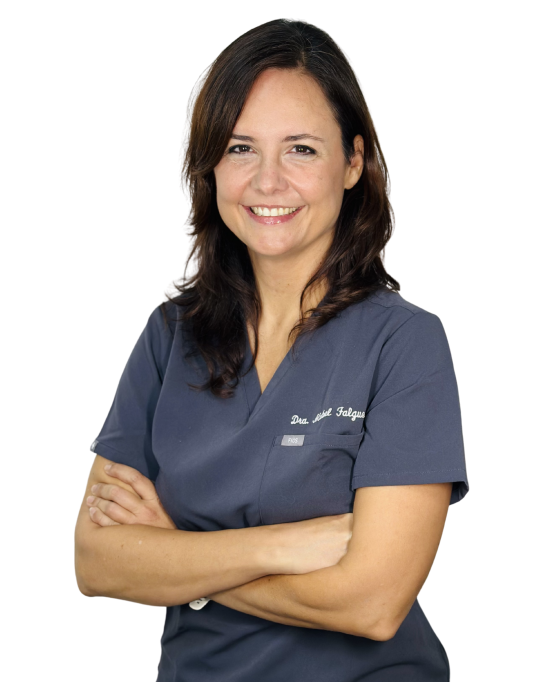
Dr. Mabel Falguera Uceda
Oral and maxillofacial surgeon specializing in facial aesthetic surgery. Trained at the University of Navarra, Hospital 12 de Octubre in Madrid and Chang Gung Hospital in Taiwan. Facial aesthetic surgeon and director of Instituto Facial in Córdoba.
View full profile - Last medical review of this page: October 2026